



Every product sends emails. But managing templates, credentials, and versions shouldn't require developers, tickets, or deployments. Tuix Email Service separates email from code, simplifies delivery, and gives your team full control over every message.
What Tuix Email Service does
Tuix Email Service takes email out of your code and puts it in your hands. Organize emails by project, design them in your browser with a live preview, and test them with sample data before writing a single line of code. Once saved, each email gets a unique ID. Your developers can send it with a single request from your product containing the ID, recipient, and data.
That means:
Content stops being a release. Wording, layout, sender and subject are edited in the dashboard, and the next email sent uses the new version. Nothing is deployed. One integration covers every email. Developers write the sending code once. Every new email after that is a new ID, not a new ticket. The emails stay yours. They keep leaving from your own address, through the provider you already use. Nothing dangerous reaches an inbox. Both the design and the data filled into it are checked before the message is built, so an email cannot carry anything that would put the recipient at risk.
Why it matters for your business
The point is not that sending email is hard. The point is that the content of your emails is business content, written by the people responsible for it, and it should not have to pass through an engineering queue to change.
For a company's leadership, this translates into concrete outcomes:
Less customer data in circulation, because the data used to build each email is discarded once it is sent. Faster reaction, with a price, a legal line or a broken sentence corrected the same day instead of waiting for the next release. Costs that stay under your control, because emails are billed by the provider you already use, at the rates you have already agreed.
Our approach
We built this because our own products needed it, we run it in production, and we opened it to other companies once it had proven itself. That's how we approach product development at Tuix: solve real problems, turn complexity into simple experiences, and build reliable, secure tools that fit naturally into the way people work.

Whoever owns the content: marketing, support, product. The editor works with the same web design language every website is built from, and the preview shows the result while you type, so the person writing can see exactly what the customer will receive. A developer is needed once, to connect your product to the service, and not again after that.
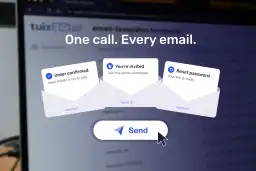
One call. They send the ID of the email, the recipient, and the values that change, and the service does the rest. We provide a ready-made package for common setups, plus public documentation with working examples, so the first email usually goes out the same day.
You do. The service connects to your own email provider using credentials you enter once, which we encrypt and never show again, not even back to you. Your emails leave from your own address and count against your own provider's account, which means the trust your emails have built up with inboxes stays intact, and changing providers later is one setting, not a migration.
Yes, and that is the reason the service has two kinds of access keys. A key meant for your servers can send anything to anyone. A key meant for a public page is deliberately limited: it can only trigger the one email you set up for it, and only to the address you configured, so a stranger who copies it out of your page can do nothing with it except send you your own contact form message. Each key also has a sending cap, which keeps a faulty loop or a bot from burning through your provider's quota.
Every request is resolved to one account before anything happens, and every email, template and send is checked against that account, so an identifier from one company is meaningless in another. The emails you design are stored privately and are never published or linked anywhere. The data you pass when sending is used to build that one message and is not kept afterwards, so customer names and order details do not accumulate on our side.


