

Most business software asks people to adapt to it. You learn the menus, memorize where things live, click through the same sequence of screens every time you need to do something routine. It works, but it's rarely effortless, and for busy teams, that friction adds up.
At Tuix, we build software the other way around: we make the software adapt to the person using it. Our AI Assistant is one of the clearest examples of that philosophy in action.
What the AI Assistant Does
The Chat AI Assistant is a conversational tool that we can build into any application. Instead of navigating menus and forms, users simply describe what they want in plain language, the Assistant reads the relevant information inside the app, understands the request, and carries it out.
That means:
No steep learning curve. New employees or occasional users can get real work done from day one, without training on every feature.
Fewer errors. The Assistant handles the app's internal logic, reducing the chance of manual mistakes.
Faster, more natural interactions. A quick sentence replaces a multi-step process.
It's not a chatbot bolted on as an afterthought, it's a genuine control tool that can operate the application on the user's behalf, securely and within the permissions assigned to them.

Proving It Works: Tuix Timesheets
Rather than pitch this as a theoretical concept, we built it into one of our own products:
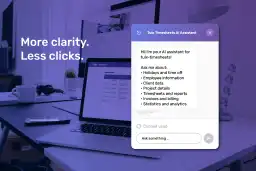
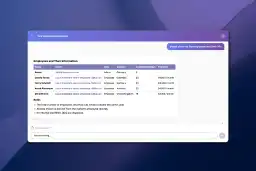
Within Timesheets, the Assistant lets employees and managers do things like log hours, check remaining leave, or pull a quick summary of a team's hours for the week, just by asking, instead of digging through reports and filters. The result was a measurable boost in day-to-day efficiency and a smoother experience for everyone using the platform, from field staff to department heads.
Why It Matters Beyond Timesheets
The technology behind the AI Assistant isn't specific to timesheets, that was simply our proving ground. The same conversational tool can be integrated into inventory systems, CRMs, internal dashboards, client portals, or any other type of application.
For a company's leadership, that translates into concrete outcomes:
Higher adoption of the tools you invest in, because employees don't need extensive onboarding.
Lower training and support costs, since the software explains and operates itself through natural conversation.
A more modern, more competitive product, for internal teams and, where relevant, for your own customers.
Our Approach
This project reflects how Tuix approaches software development in general: we don't just deliver a working application, we look for ways to make it genuinely easier for the people who use it every day. The AI Assistant is one tool in

Log hours, check available leave, or ask for a quick summary of a team's hours for the week, in plain sentences, the way you'd ask a colleague. No commands or menus to memorize.
The Assistant only operates within the requesting person's existing role and permissions. It can access or change exactly what that person could already access or change themselves, nothing more.
Yes. It's built to understand requests in multiple languages, which matters for distributed or multilingual teams.
Tuix Timesheets is where we proved it first, but the same conversational layer can be built into inventory systems, CRMs, dashboards, or any other application your business runs on.
Behind the scenes, your question is interpreted, matched to the right action inside the app, checked against your existing permissions, and carried out, all in the time it takes to read this sentence.